
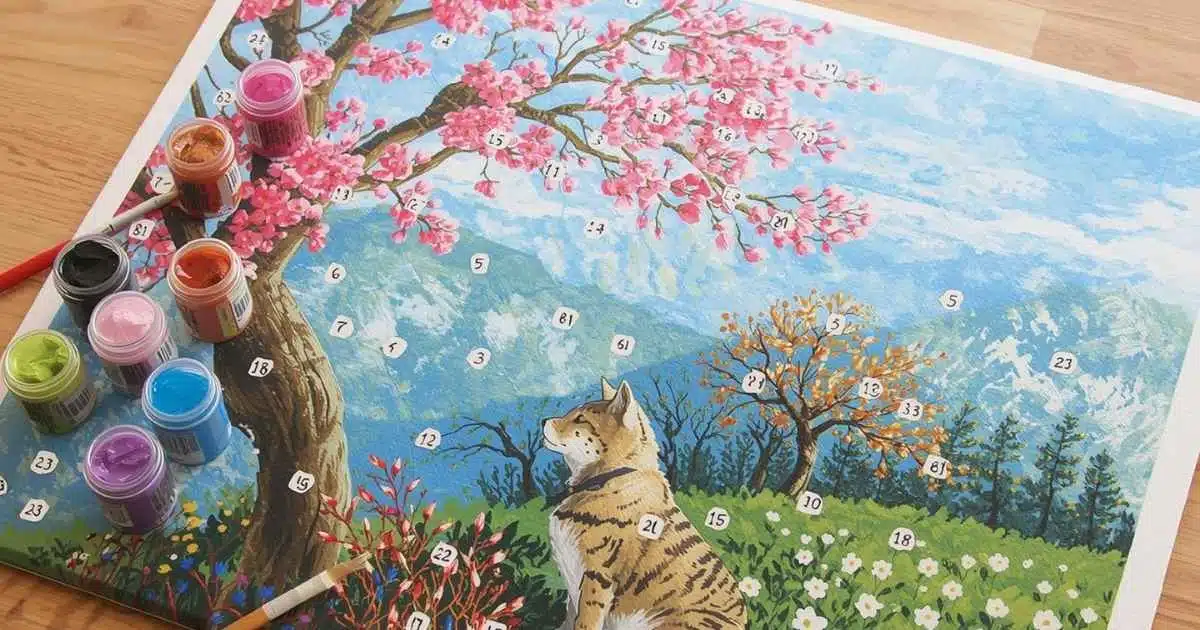
You get a canvas with numbered sections, paints in matching numbered pots, and brushes. Match each number on the canvas to the same numbered paint, fill in those sections, and repeat until the entire image is complete. No artistic skill required.
Think of it as coloring by numbers, but with real paint. The canvas tells you exactly where each color goes. You just fill in the blanks and end up with a finished painting worthy of your wall.
Let me walk you through the entire process, from opening the box to hanging your finished artwork.
What You Get in a Paint by Numbers Kit
How paint by numbers works starts with understanding what’s in your box.
The Canvas: Your canvas arrives pre-printed with the complete design. Every section has a number inside it. These numbers correspond to specific paint colors. The canvas is usually pre-stretched on a wooden frame, ready to paint immediately.
Shomaz Brand canvases come mounted and ready. No assembly needed.
The Paints: Small pots of acrylic paint, each labeled with a number. The number on the pot matches the numbers on your canvas. Open pot 5, paint all the sections marked 5. Simple as that.
Quality matters here. Cheap paints need 4-5 coats to cover properly. Good paints cover in 1-2 coats. Shomaz kits use thick, pigment-rich acrylics that actually cover.
The Brushes Most kits include three brushes:
- Fine-tip brush: For tiny details and small sections
- Medium brush: For most of your painting
- Large brush: For big background areas
Some sections are the size of your fingernail. Others are the size of your palm. Different brushes handle different jobs.
Reference Sheet: A picture showing what your finished painting should look like. Helpful when you need to see the big picture or verify you’re using the right colors.
How Paint by Numbers Works Step by Step
Here’s the actual process, broken down so a beginner can follow along.
Step 1: Set Up Your Workspace
Find a spot with good lighting. Natural light works best, but a bright lamp does the job too.
Cover your table with newspaper or an old cloth. Acrylic paint washes off easily when wet but stains when dry.
Grab a cup of water for rinsing brushes and some paper towels for wiping.
Set out all your paint pots and check that you have every number listed on your canvas. Nothing worse than getting halfway through and realizing you’re missing paint 23.
Step 2: Choose Your Starting Point
You can start anywhere. Seriously.
Popular strategies:
Work by number: Paint all the 1s, then all the 2s, then all the 3s. Keeps you from constantly switching paint colors. Less brush cleaning.
Work by section: Pick one area of the painting and complete it entirely. Lets you see progress faster. More satisfying.
Light to dark: Paint lighter colors first. If you mess up and go outside the lines, darker colors cover mistakes better than light ones.
Background first: Some people paint the background, then work forward to the focal point. Others do the opposite.
Try different approaches and see what feels natural. There’s no wrong way.
Step 3: Start Painting
Pick a number. Find all the sections with that number on your canvas.
Open the matching paint pot. Dip your brush about halfway into the paint. You don’t need globs. Too much paint creates thick, uneven layers that take forever to dry.
Fill in one section completely. Stay inside the lines as much as possible, but don’t stress if you go over a bit. You can fix it later.
Move to the next section with the same number. Keep going until you’ve painted every section marked with that number.
Pro tip: Work on non-adjacent sections when possible. Paint section 1 in the top left, then section 1 in the bottom right. By the time you come back to paint the section next to your first one, it’ll be dry. No smudging.
Step 4: Clean Your Brush Between Colors
This matters more than you think.
Dip your brush in water. Swirl it around. Wipe on paper towel. Repeat until the water runs clear and no paint comes off on the towel.
Dirty brushes muddy your colors. Paint 12 might be a bright yellow, but if your brush has leftover blue from paint 6, you’ll get green instead.
Step 5: Apply Second Coats When Needed
First coat often looks streaky or thin. You can see the numbers through it. Totally normal.
Let it dry completely (20-30 minutes), then add a second coat. Most sections need two coats for solid coverage.
Some sections might need three coats. Light colors over dark sections, especially. Don’t get frustrated. Just keep layering.
Step 6: Work Through All the Numbers
Keep painting, number by number, until you’ve covered the entire canvas.
The image emerges gradually. At first, it looks like random colored blobs. Then shapes start making sense. Details appear. By the time you’re 75% done, you can clearly see what it is.
That moment when it clicks together? Absolutely satisfying.
Step 7: Let It Dry Completely
Once you’ve painted the final section, step back and admire your work. But don’t touch it yet.
Let the whole thing dry for 24 hours minimum. Acrylic paint feels dry after an hour, but it’s not fully cured. Touch it too soon and you’ll leave fingerprints or smudge something.
Step 8: Optional Finishing Touches
Varnish: Spray a clear acrylic varnish over your finished painting. Makes colors pop and protects against dust and fading. Totally optional but recommended.
Touch-ups: See a spot you missed? A place where colors bled together? Fix it now. Small touch-ups are way easier than you’d think.
Sign it: Yeah, you painted it. Put your signature in the corner. Why not?
Step 9: Display Your Art
Shomaz Brand kits come on frames, so you can hang them as-is. Just add picture hanging hardware to the back.
For unmounted canvases, take them to a frame shop or buy a ready-made frame.
Hang it somewhere you’ll see it often. You put hours into this thing. Show it off.
Understanding the Paint by Numbers System
How paint by numbers works relies on a clever system developed by professional artists.
The Design Process
Artists and designers create these templates using sophisticated software. They start with a photo or painting. The software analyzes it and breaks it down into paintable sections.
Each section gets assigned a specific color. The software groups similar shades together and determines how many distinct colors are needed. Beginner kits use 20-25 colors. Advanced kits might use 50+ colors for more detail.
The result is a numbered template that preserves the original image’s composition, lighting, and depth.
Why It Works So Well
The hard parts are done for you:
- Color selection and mixing
- Composition and layout
- Shading and depth
- Proportions and perspective
You’re following a professional roadmap. Even if you’ve never painted before, you’re using techniques and color combinations that artists use.
That’s why finished paintings look way better than you’d expect. You’re not winging it. You’re executing a plan designed by someone who knows what they’re doing.
Common Questions About the Process
How long does it take?
Depends on size and complexity. Simple designs with large sections: 4-8 hours total. Complex designs with tiny sections: 15-25 hours.
You don’t do it all at once. Paint for an hour here, two hours there. Most people finish within 2-4 weeks painting casually.
Do I paint in any specific order?
Nope. The numbers don’t need to be done sequentially. Paint number 17 before number 3 if you want. The order doesn’t matter.
What if I run out of paint?
Quality kits include extra paint for exactly this reason. Shomaz Brand pots have more paint than you need. If you somehow run out, contact their customer service for replacements.
Can I mix colors?
You can, but you don’t have to. The kit provides everything you need. Mixing is for advanced painters who want custom shades.
What if the numbers show through?
Use more coats. Three or four thin coats cover better than one thick coat. If numbers still show, add a coat of white paint first, let it dry, then apply your color over it.
Do I need to seal the paint pots?
Yes. Twist the lids tight after every use. Acrylic paint dries fast. Leave a pot open overnight and you’ll find dried, unusable paint in the morning.
Tips for Better Results
Start with easy kits: Your first painting shouldn’t be a complex landscape with 50 colors. Try something with larger sections and fewer colors. Browse beginner-friendly options here.
Paint in good lighting: You need to see the numbers clearly and distinguish between similar colors. Natural daylight is ideal.
Keep paint thin: Multiple thin coats beat one thick coat every time. Thin coats dry faster, look smoother, and cover better.
Clean brushes thoroughly: Seriously. This makes such a huge difference in color accuracy.
Take breaks: Your eyes get tired. Your hand gets cramped. Paint for an hour, then step away. Come back fresh.
Don’t stress perfection: Going slightly outside the lines won’t ruin anything. Nobody will notice but you. The overall image is what matters, not individual sections.
Use a magnifying glass for tiny sections: If you’re over 40 or the sections are super small, a magnifying glass helps immensely.
Why People Love This Hobby
How paint by numbers works isn’t just about the technical process. It’s about what happens while you’re painting.
Your brain shifts into a different mode. You stop thinking about work stress, bills, family drama, whatever’s been bugging you. You focus on this one simple task: fill in this section with this color.
It’s meditative without trying to be. The repetitive motion, the gradual progress, the small wins as each section gets completed. It quiets your mind in a way scrolling social media never does.
Plus, you end up with something tangible. You can point at it and say, “I made that.” In a world where most of our work is digital and invisible, that matters.
Custom Paint by Numbers
Want to paint something personal? Custom paint by numbers kits turn your photos into paintable templates.
How it works:
- Upload your photo (pet, family, wedding, vacation)
- Company converts it to a numbered template
- Kit arrives with your custom design
- Paint your own memory
Popular choices:
- Pet portraits (especially dogs and cats)
- Wedding photos
- Baby’s first photo
- Graduation pictures
- Favorite vacation spots
- Memorial tributes for loved ones
The conversion quality matters. Good companies preserve detail without over-complicating the template. Shomaz Brand’s custom service strikes that balance well.
Different Types of Paint by Numbers
How paint by numbers works varies slightly by type.
Standard Kits: Pre-designed images. Landscapes, animals, famous paintings, cities. Hundreds of designs available. Browse the collection here.
Large Format Bigger canvases (24″x36″ or larger) for more dramatic wall art. More sections, more detail, longer painting time.
Mini Kits: Small canvases (8″x10″ or smaller) that take 2-4 hours to complete. Great for beginners or quick projects.
Advanced Kits 50+ colors, tiny sections, complex shading. For experienced painters who want a challenge.
Group Projects: Massive canvases designed to be painted by multiple people. Popular for team-building events or family activities.
Tools That Make It Easier
Magnifying lamp: Combines bright light with magnification. Game-changer for detail work.
Brush set: Beyond the included brushes, adding a few extra sizes gives you more control.
Paint palette: For mixing custom shades or thinning paint with water.
Easel: Holds your canvas at a comfortable angle. Beats hunching over a table.
Varnish spray: Protects finished paintings and makes colors more vibrant.
You don’t need any of this to start. But if you get hooked on the hobby, these tools improve the experience.
Final Thoughts
How paint by numbers works is beautifully simple: numbered sections, matching paints, fill in the blanks. But the experience goes deeper than that.
You’re creating something. You’re practicing focus and patience. You’re proving to yourself you can finish what you start. You’re making art without needing years of training.
Your first kit might feel awkward. You’ll question if you’re doing it right. By hour three, you’ll be in the zone. By the end, you’ll be proud of what you made.
Grab a beginner kit from Shomaz Brand and try it. You’ll either discover a new favorite hobby or waste $25. Those are pretty good odds.
Either way, you’ll have tried something new. And that’s always worth it.